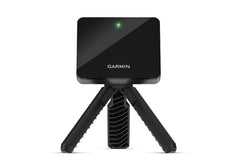
The Garmin Approach R10 and the Garmin Approach R50 are not really competitors. The R10 is a $499.99 pocket-sized Doppler radar that runs 10 hours on a charge and tracks your shots through the Garmin Golf app on your phone. The R50 is a $4,999.99 three-camera photometric unit with a built-in 10-inch touchscreen that plays Home Tee Hero on-device without a PC or tablet. Same brand, same Garmin Golf ecosystem, very different jobs.
This guide walks through the actual buying decision: how the two units track shots, how they fit indoors versus the range, what each one needs in software and subscriptions, and which golfer profile each one is built for.
Garmin R10 vs R50 Quick Verdict
Buy the Garmin R10 if you want a small, all-weather unit you can throw in your bag, take to the driving range, and still use for casual basement sim sessions with your phone or tablet. At $499.99 with 10 hours of battery and an IPX7 water rating, it is the most portable Garmin launch monitor and one of the strongest value picks at its price point.
Buy the Garmin R50 if you are building a home simulator and do not want a PC, tablet, or phone in the loop. The built-in 10-inch touchscreen plays Home Tee Hero natively, an HDMI output drives a projector or TV, and three high-speed cameras handle the photometric tracking. It is the only camera-based launch monitor at this price tier with a full simulator on the device itself.
If you are also cross-shopping outside the Garmin line, the same indoor-vs-outdoor framing comes up on the SkyTrak ST MAX vs Garmin R10 and full Garmin R50 review.
What Each Launch Monitor Actually Is
The R10 and R50 sit at opposite ends of the Garmin launch monitor lineup, and the difference is mostly in how they capture shots and where they show the data.

- Garmin Approach R10 ($499.99). Compact Doppler radar unit that sits 6 to 8 feet behind the ball, tracks more than a dozen ball and club metrics, and pairs over Bluetooth with the Garmin Golf app on a phone or tablet. No on-device screen. Battery, IPX7 water rating, and a 5.22 oz body make it the only Garmin launch monitor designed for outdoor and range use as much as indoor sim use.
- Garmin Approach R50 ($4,999.99). Full-size three-camera photometric unit that sits beside the ball, tracks more than 15 ball and club metrics with measured spin rate and spin axis, and runs Home Tee Hero, Driving Range, Training Mode, and impact video review on its built-in 10-inch color touchscreen. HDMI output mirrors to a projector or TV. Designed to anchor a home simulator bay, not double as a range tool.
Side-by-Side Spec Comparison
| Spec |
Garmin Approach R10
|
Garmin Approach R50
|
|---|---|---|
| Price (TSG) | $499.99 | $4,999.99 |
| Tracking Technology | Doppler radar | Three high-speed cameras + barometer |
| Metrics Tracked | More than a dozen ball & club metrics | More than 15 ball & club metrics (measured spin) |
| Display | None on unit (uses phone/tablet) | 10" color touchscreen, 800 x 1280 px |
| Plays Without a PC? | Phone or tablet via Garmin Golf app | Yes -- native Home Tee Hero on device |
| Battery | Up to 10 hours | Up to 4 hours (AC included) |
| Connectivity | Bluetooth | Wi-Fi, Bluetooth, USB-C, HDMI output |
| Water Rating | IPX7 (immersion-grade) | IPX3 (light splash, indoor unit) |
| Operating Temperature | 14°F to 131°F | 14°F to 131°F |
| Dimensions | 3.5" W x 2.8" H x 1" D | 16.5" W x 10.6" H x 7.5" D |
| Weight | 5.22 oz (no tripod) | Approx. 9 lb (4.1 kg) |
| Club Marker for Club Data? | No | Yes (250 face stickers in box) |
| Native Sim Software | Home Tee Hero on phone/tablet | Home Tee Hero on built-in screen |
| Third-Party Sim Software | GSPro, E6 Connect, E6 APEX, Awesome Golf, Creative Golf 3D | GSPro, E6 Connect / E6 GOLF, Awesome Golf (separate licenses) |
| Garmin Golf Membership | Required for Home Tee Hero ($9.99/mo or $99.99/yr) | Required for Home Tee Hero ($9.99/mo or $99.99/yr) |
| In the Box | R10, tripod, phone clip, carrying case, USB cable | R50, AC adapter, carrying case, 250 stickers, docs |
| Warranty | 1-Year Limited (Garmin) | 1-Year Limited (Garmin) |


R10 vs R50 Tracking: Doppler Radar vs 3-Camera Photometric
The two units use very different sensor stacks, and that drives almost every other decision below.
The R10 uses a single Doppler radar antenna positioned behind the ball. Radar measures the ball in flight and uses that flight data to derive club delivery numbers. Radar needs ball flight to read accurately, so the R10 wants ball flight room: Garmin recommends about 8 feet of flight into a net or screen; we plan 18 feet of room depth, with a 9-foot ceiling for full driver swings. Outdoors at the range, that ball-flight constraint goes away and the unit works exactly as designed.
The R50 uses three high-speed cameras and a barometer positioned beside the ball. Photometric tracking captures the ball and club at impact rather than inferring them from flight, so the R50 reads cleanly in shorter rooms: about 10 feet into a net, 14 to 16 with a screen. The barometer corrects for conditions. Camera-based reading means club metrics need a tracking marker on each clubface (250 face stickers ship in the box), but ball metrics work without any setup.
For everyday accuracy in an indoor bay, the photometric R50 pulls ahead because it directly measures spin rate and spin axis instead of calculating spin axis from ball flight. For outdoor range work where there is no ball-flight constraint, the gap closes and the R10's radar handles full-distance shots without needing a screen at all.
Indoor Simulator vs Outdoor Range: Which Fits Your Setup?
This is usually the question that decides the purchase. The R10 and R50 are optimized for opposite environments.

- Outdoor and range use. The R10 is the right tool. IPX7 water resistance, 10 hours of battery, a 5.22 oz body, and a tripod that fits in the included carrying case make it the only Garmin launch monitor you can take to the range every day without a power source. The R50 is rated IPX3 (light splash) and weighs about 9 lb -- treat it as an indoor unit that can move outdoors occasionally, not a range tool.
- Compact indoor sim bays (10 to 16 feet of depth). The R50 wins because photometric tracking reads cleanly in shorter rooms. The R10 still works indoors but wants more flight depth and a net or screen to track full shots.
- All-in-one simulator setups. The R50 plays Home Tee Hero on its own touchscreen and drives a projector or TV through HDMI without a PC or tablet. The R10 needs a phone or tablet to run the Garmin Golf app, and a separate display source if you want a big-screen sim experience.
- Travel and multi-room use. R10 wins on portability by every measure. Pocket-size and tripod-stable, it goes from basement bay to course to range without ceremony. The R50's carrying case fits the unit and its AC adapter, but at ~9 lb it is a "moves between rooms" unit, not a "fits in your golf bag" unit.
- Built-from-scratch bays. Garmin sells turn-key packages for both units. The R10 DIY Enclosure Golf Simulator bundles enclosure, screen, projector, mount, and mat for a complete R10 bay. The R50 DIY Enclosure Golf Simulator does the same for the R50 with sizing matched to the larger unit. Browse all R10 and R50 themed packages on our Garmin collection page.
Software, Memberships, and What You Actually Pay
Both units share the Garmin Golf ecosystem, but the way you interact with that software is different, and so are the third-party simulator options.

- Home Tee Hero (Garmin's native sim). Both the R10 and R50 play Home Tee Hero with 43,000+ virtual courses. Both require an active Garmin Golf Membership ($9.99/month or $99.99/year per Garmin's site). The difference is where: the R10 runs Home Tee Hero through the Garmin Golf app on your phone or tablet, while the R50 runs it natively on its built-in 10-inch touchscreen and can mirror to a projector or TV through HDMI.
- Third-party simulator software. The R10 connects to GSPro, E6 Connect, E6 APEX, Awesome Golf, and Creative Golf 3D. The R50 connects to GSPro over Wi-Fi from a Windows PC, plus E6 Connect / E6 GOLF through TruGolf's connection workflow and Awesome Golf, each licensed separately. Neither unit bundles a third-party license with the Garmin Golf Membership.
- Garmin Golf app features outside the sim. Both sync dispersion and history to Garmin Golf; R10 video uses your phone's camera. If you already use a Garmin Approach handheld or watch, your data lives in the same ecosystem.
- Total first-year software cost. Plan on at least $99.99 for the annual Garmin Golf Membership if you want Home Tee Hero on either unit. Add the cost of any third-party title you choose (GSPro, E6 Connect / E6 GOLF, Awesome Golf) on top of that, regardless of which Garmin unit you buy.
Do You Need a Subscription for the R10 or R50?
Yes for Home Tee Hero on either unit -- both need an active Garmin Golf Membership ($9.99/month or $99.99/year) to play the 43,000+ Home Tee Hero courses. No for basic launch monitor practice -- both units capture shot data and let you train without any subscription. Third-party simulator software (GSPro, E6 Connect / E6 GOLF, Awesome Golf, Creative Golf 3D) is licensed separately on top of either unit and is not bundled with the Garmin Golf Membership.

Accuracy Reality Check: What Each Unit Is Actually Better At
Both units are accurate enough to train against -- they just measure different things in different ways, and that matters more than a raw number.

- Ball speed and launch angle. Both units read these cleanly. The R10's radar measures launch from the ball's first inches of flight; the R50's cameras measure launch at impact. Either reading is usable for distance work.
- Spin rate and spin axis. The R50 measures spin rate and spin axis directly off the camera frames. The R10's radar measures total spin rate but calculates spin axis from ball flight -- reliable outdoors, and indoors it can measure spin directly when you use Titleist RCT balls. If spin axis and curve shapes matter (fitting work, shaping practice), the R50 is in a different accuracy class.
- Carry and total distance. The R10's radar handles full-distance shots outdoors without needing a screen -- watch a real shot fly to the green and it tracks the whole arc. The R50 calculates carry and total from impact data plus Garmin's flight model. Both are usable; the R10 is the better outdoor distance tool.
- Club delivery numbers. The R50 captures club path, face angle, and angle of attack from face stickers. The R10 estimates a smaller club set (club head speed, club path angle, club face angle) and is less precise on attack angle and face-to-path because radar derives those from flight.
- Real-world setup discipline. R10 accuracy lives or dies by tripod placement (6 to 8 feet behind the ball, level, clean ball-flight line). R50 accuracy lives or dies by level side placement and clean stickers. Neither tolerates lazy setup.
$499.99 vs $4,999.99: Where the Money Goes
The $4,500 jump from R10 to R50 buys camera tracking Garmin rates more accurate, plus the on-device simulator hardware. The R50 includes a 10-inch color touchscreen, three high-speed cameras, a barometer, HDMI out, Wi-Fi, USB-C, and the on-device Home Tee Hero stack. The R10 is a single Doppler radar antenna in a 5.22 oz body with Bluetooth back to a phone you already own.

Where the math gets interesting is total cost of ownership for a complete sim bay. With the R50, the touchscreen and the native simulator software are already in the box; you still need an enclosure, mat, and either an impact screen or a projector if you want a big-screen experience. With the R10, you need to budget for a phone/tablet stand (most golfers already have the device), a sim PC and licenses if you want GSPro or another third-party title on a large display, plus the enclosure, mat, and screen.
For a budget basement sim driven from a tablet, the R10 path costs a fraction of the R50 path. For a premium home bay where you do not want a PC, a tablet, or a phone in the loop, the R50 is the cleanest single-purchase answer on the market.
Who Should Buy the Garmin R10
- Range and outdoor practice golfers. The R10 was built for this. IPX7, 10-hour battery, 5.22 oz, fits in a golf bag pocket. No competing Garmin unit even tries.
- Budget-conscious sim builders. At $499.99 the R10 keeps a credible basement sim affordable once you add an enclosure, mat, screen, and a tablet you already own.
- Garmin Approach handheld / watch owners. Use Garmin Golf on a handheld or a Garmin Fenix 9? The R10 syncs shot data to the same Garmin Connect account.
- Travel-and-play golfers. Take it to the range, take it to your buddy's basement, take it on vacation. Pocket size and a real battery are a unique combination at this price point.
- Cross-shoppers under the $1k mark. The R10 competes with the SkyTrak ST MAX and Swing Caddie SC4 PRO. See our ST MAX vs R10 and SC4 PRO vs R10 comparisons if you want full head-to-head reads against those.

Who Should Buy the Garmin R50
- Home sim builders who do not want a PC. This is the R50's sharpest fit. Home Tee Hero on the touchscreen plus HDMI to a projector is the cleanest all-in-one home simulator path on the market.
- Compact-bay owners. Camera-based side placement reads cleanly in 10-foot net rooms where radar units want more depth.
- Buyers building from scratch. The R50 DIY Enclosure Golf Simulator bundles enclosure, screen, projector, mount, and mat in a single SKU.
- Golfers who want measured spin rate and spin axis. Direct photometric spin measurement is the R50's biggest accuracy advantage over the R10 and over almost every other launch monitor in this price tier.
- Mixed-handedness households. Center Line Offset on the R50 (added in software 4.10) shifts the target line on the external display for offset hitting setups, and Home Tee Hero supports per-player handedness inside multi-golfer sessions.
Garmin R10 and R50 at Top Shelf Golf
Garmin Approach R10

- Doppler radar tracking
- More than a dozen metrics
- 10-hour battery, IPX7
- 3.5" x 2.8" x 1", 5.22 oz
- Bluetooth to Garmin Golf app
- Tripod + phone clip included
- 1-Year Garmin warranty
- Pocket-size for range and travel
- All-weather IPX7 build
- Full Garmin Golf ecosystem
- Affordable sim entry point
- Needs a phone/tablet to play
- Needs 8+ ft of ball flight indoors
- Spin axis calculated, not measured
- No on-device display
Garmin Approach R50

- 3 high-speed cameras + barometer
- More than 15 ball & club metrics
- 10" color touchscreen, 800 x 1280
- 4-hour battery; AC included
- Wi-Fi, Bluetooth, USB-C, HDMI
- IPX3 water rating
- 250 club tracking stickers in box
- Native Home Tee Hero on 10" screen
- Measured spin rate and spin axis
- HDMI to projector -- no PC required
- Camera tracking fits compact bays
- $4,999.99 is a serious commitment
- Club data needs face stickers
- 4-hour battery (vs R10's 10)
- IPX3 only -- keep dry outdoors
Bottom Line: Which Garmin Launch Monitor Should You Buy?
Pick the Garmin R10 if portability, range use, and budget matter more than indoor sim simplicity. At $499.99 it is one of the most useful golf tools you can own, especially if you already use the Garmin Golf app on a phone or watch.
Pick the Garmin R50 if you are building a home simulator and want a single device that handles tracking, simulation, and display without a PC, tablet, or phone in the loop. The on-device 10-inch touchscreen, measured spin, and HDMI output are the premium you are paying for, and at $4,999.99 there is no other camera-based launch monitor that bundles all three.
If neither one is quite right, the Garmin R50 review covers the R50 against the Bushnell Launch Pro Circle B and Foresight GC3, and our SkyTrak ST MAX vs Garmin R10 guide covers the R10 against the next best portable launch monitor in the same price tier.